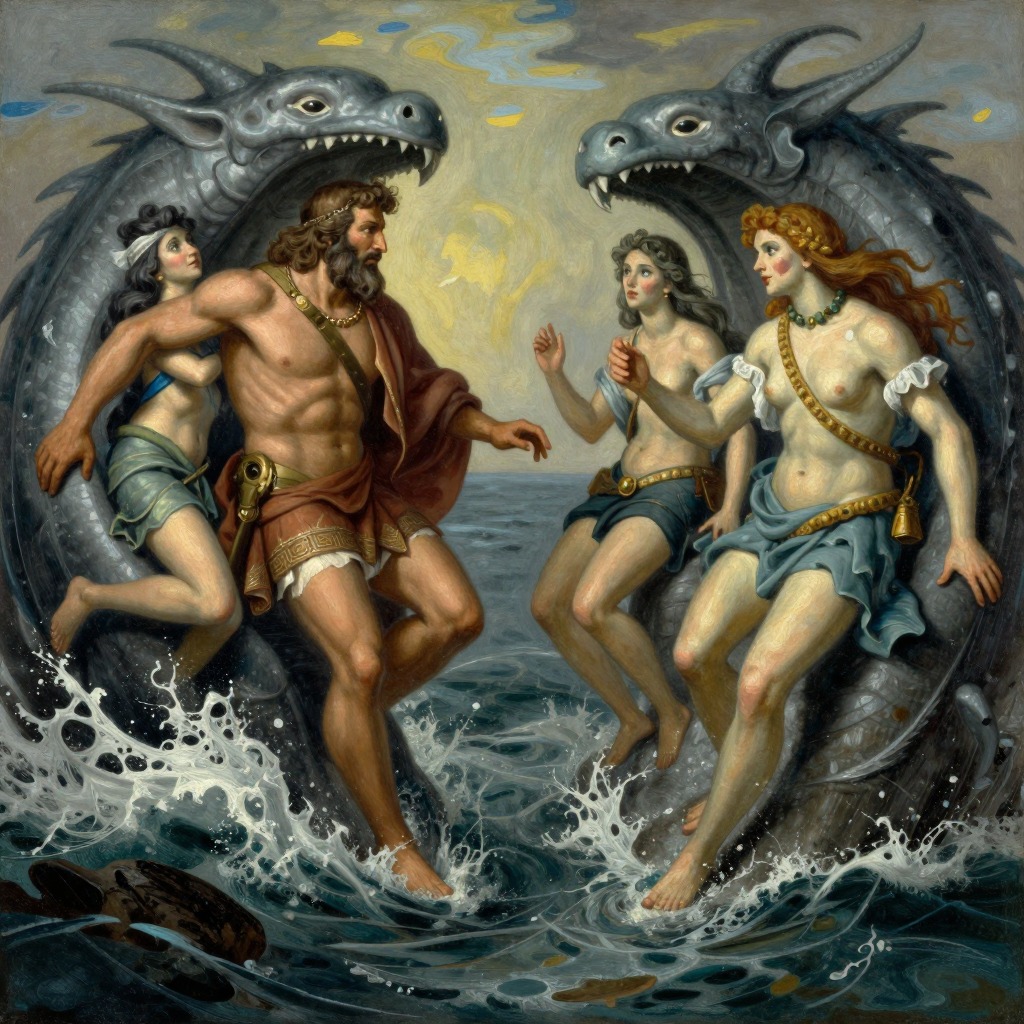
Charybdis
Charybdis is a marine goddess and a monstrous whirlpool who, together with the man-eating Scylla, guards a narrow strait that Odysseus must navigate on his homeward voyage. She represents the most elemental and impersonal of the dangers the hero faces—a force of nature that swallows and vomits the sea three times a day, leaving no room for negotiation, cunning, or mercy. Her presence in the poem crystallizes the theme of unavoidable loss: even the cleverest mortal cannot outwit a whirlpool, and must accept the sacrifice she demands.
Nature and Description
Charybdis is not a creature with a body or a voice but a geological and divine phenomenon. She sits beneath a large fig tree in full leaf, lodged under a low-lying rock that is a bow-shot away from Scylla's cliff. Three times each day she sucks down the dark salt water, and three times she vomits it forth again, creating a whirlpool so violent that when she swallows, the water inside spins round and round, revealing a black, sandy, muddy bottom, and the crash of the water against the rocks produces a deafening roar. Circe warns Odysseus that if his ship is caught in the whirlpool when Charybdis is sucking, not even Poseidon himself could save him. The description emphasizes her absolute, mechanical regularity: she is a rhythm of destruction, not a sentient antagonist.
Odysseus's Passage
Odysseus faces Charybdis twice. On the first passage, following Circe's instructions, he hugs Scylla's side and drives the ship past as fast as possible, losing six men to Scylla but saving the vessel from the whirlpool. The crew rows in terror as the water churns and the spray reaches the top of the rocks on either side. Later, after the destruction of his ship and the death of all his remaining comrades, Odysseus is carried back to Charybdis alone. Clinging to the mast and keel lashed together, he is swept aloft toward the fig tree, which he catches hold of and hangs from like a bat, unable to plant his feet anywhere securely. He hangs there patiently, waiting for the whirlpool to discharge his makeshift raft again, and when it does, he lets go and falls heavily into the sea, then climbs onto the raft and rows with his hands. Scylla does not see him this time, and he escapes.
Consequences and Aftermath
Charybdis is the final natural obstacle Odysseus overcomes before his long drift to Calypso's island. The passage through her strait costs him his entire crew and his ship, leaving him utterly alone. The experience reduces the hero to a purely physical struggle for survival—hanging from a tree, waiting, falling—with no room for strategy or speech. The whirlpool's indifference contrasts sharply with the personal vendetta of Poseidon or the targeted malice of Polyphemus; Charybdis destroys not out of anger but because that is her nature. In the poem's moral geography, she represents the kind of disaster that cannot be blamed on human folly or divine wrath, only on the brute fact of a dangerous world.
Narrative Role and Significance
Charybdis functions as a limit-case for Odysseus's characteristic virtue of metis (cunning intelligence). Against her, there is no trick, no disguise, no persuasive speech that can help; the only response is to endure and accept the loss. She also serves as a structural counterpart to Scylla: where Scylla is a personal, predatory monster who snatches and eats specific men, Charybdis is an impersonal, elemental force that threatens the whole ship. Together they frame the strait as a space of unavoidable sacrifice, teaching Odysseus—and the audience—that even the most resourceful hero must sometimes pay a price he cannot negotiate down.